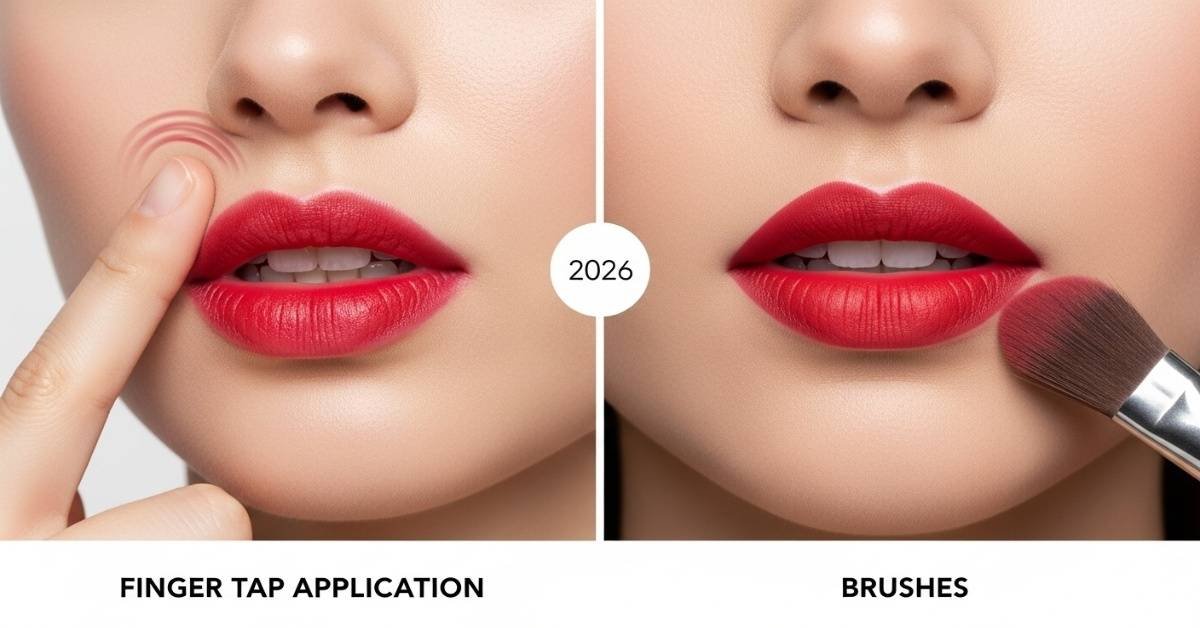
I remember sitting backstage at a fashion show in New York a few years ago, watching a world-renowned makeup artist work on a top model. He had a brush set that probably cost more than my first car, but when it came time for the lips, he did something that shocked me. He put the brushes down, took a deep berry shade on his thumb, and started tapping it onto the model’s lips. Finger Tap Application vs. Brushes.
The result was that ethereal, soft-focus finish we all crave. I went home that night and tried to do the same with my trusty detail brush, but it just wasn’t the same. It was too “perfect,” too clinical. That’s the heart of the 2026 Blurred Lip Trend. While brushes are the kings of precision, the Finger Tap Application is the undisputed queen of the “blur.”
If you’re caught between the clinical accuracy of a tool and the organic warmth of your own hands, let’s break down which method truly wins for your everyday aesthetic.
This comparison is part of our Lipstick Comparisons series, designed to help you choose the right prep methods before applying lipstick.
The 2026 Aesthetic: Why “Blur” is the Goal
In 2026, the USA beauty market has moved away from the “Instagram Face”—those heavy, carved-out features that looked great in photos but like a mask in person. Today, we want Lipstick Blending that looks like we’ve just spent the afternoon sipping espresso in a Parisian cafe.
The “blur” is about removing the harsh border between your lipstick and your skin. It makes the mouth look softer, fuller, and—let’s be honest—a lot more kissable. But achieving this requires a specific kind of pressure and heat.
The Case for Finger Tap Application: Organic Warmth
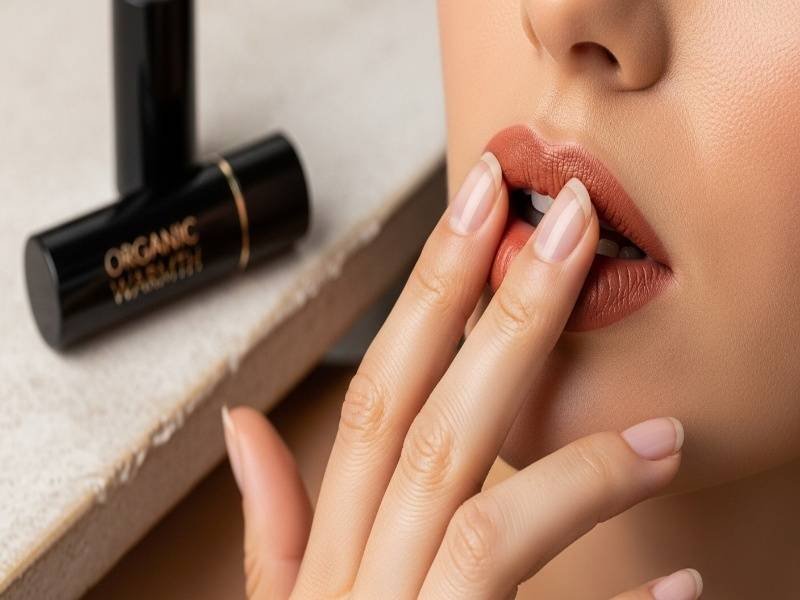
Many women ask, “is it better to blend makeup with fingers?” When it comes to the lips, the answer is often a resounding yes. Your fingers provide two things a brush cannot: natural oils and body heat.
When you use the Finger Tap Application, the heat from your skin literally melts the lipstick into your lip texture. This creates a “stain” effect rather than a “paint” effect. If you’ve already read our finger tap application ultimate guide 2026, you know that this method is the fastest way to achieve that “cloud” look.
The finger is a blunt tool. That “bluntness” is actually an advantage for the Blurred Lip Trend. It prevents you from creating a sharp line, naturally forcing the pigment to diffuse at the edges.
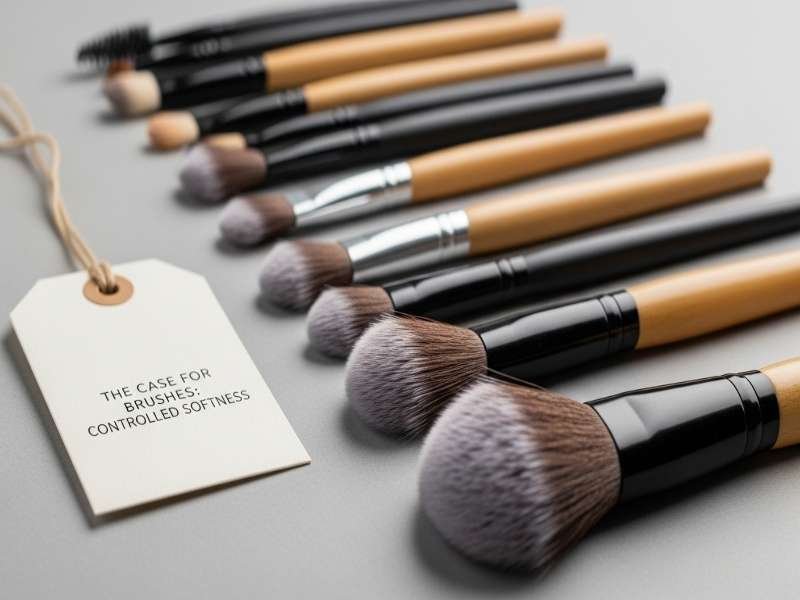
The Case for Brushes: Controlled Softness
Now, don’t throw your brush set away just yet. You might be wondering, “what is a blurring makeup brush used for?” These are usually small, fluffy brushes (often looking like mini eyeshadow blending brushes) designed to mimic the effect of a finger but with more control.
If you are someone who likes the look of a blur but has a very shaky hand, a brush might be your best bet. You can master the brush application technique for 2026’s best lip contouring to get a 3D effect that still feels structured.
However, a brush will always sit “on top” of the skin more than a finger will. Brushes are great for Lipstick Blending when you are using high-pigment liquid lipsticks that dry down too fast for your fingers to handle.
Beyond the Lips: The Full Face Debate
The “Fingers vs. Brushes” debate is everywhere. For example, “is it better to apply concealer with a brush or finger?”
- Fingers: The ring finger is perfect for the under-eye area. The warmth prevents the concealer from settling into fine lines—a common mistake to avoid.
- Brushes: A small, flat brush is better for “carving” the edge of your lip or covering a specific blemish.
Even for foundation, many are asking, “can I blend skin tint with fingers?” Absolutely. In 2026, skin tints are formulated to be worked in like a moisturizer. Using your hands ensures you don’t waste product and gives you that “flawless” skin-like finish.
Comparison: Finger Tap vs. Blurring Brush
| Feature | Finger Tap Application | Blurring Brush |
| Finish | Very Soft, “Melted” | Soft but Defined |
| Speed | 30 Seconds | 2 Minutes |
| Control | Low (Organic) | High (Technical) |
| Best For | Creamy Lipsticks & Tints | Liquid Mattes & Contouring |
If you are looking for the absolute best way to transition into this style, I highly recommend you master the finger tap application for 2026. It is the most “human” way to do makeup.

Final Thoughts: Which Gives the Better Blur?
In my personal experience—and looking at the top trends in the USA for 2026—the Finger Tap Application wins for the “ultimate” blur. There is just no mechanical tool that can replicate the way a human finger presses pigment into the skin.
Brushes are incredible for structure, but for that romantic, hazy, “I just had a great day” glow, your hands are your best assets. Can you do makeup without brushes? Yes, and in 2026, it’s actually a sign of a true pro to know when to put the tools down.
❓ Frequently Asked Questions (PAA Style)
1. Are makeup brushes better than fingers?
Neither is “better” in a vacuum. Brushes are superior for high-definition, sharp lines, and intricate eye looks. Fingers are superior for “skin-first” finishes, cream products, and achieving the Blurred Lip Trend because they melt the product into the skin.
2. What is a blurring makeup brush used for?
A blurring brush is a small, soft-bristled tool used to buff out the edges of concealer or lipstick. It is designed to create a soft-focus effect without the mess of using fingers, though it often provides less “melt” than skin-to-skin contact.
3. Is it better to apply concealer with a brush or finger?
For the under-eye, the ring finger is often better as the warmth prevents “creasing.” For spot concealing a blemish, a brush is better because it allows you to deposit a concentrated amount of pigment exactly where it’s needed without smearing it.
4. Can you do makeup without brushes?
Yes! Many 2026 beauty routines are entirely brush-free. With the rise of cream-to-powder formulas, skin tints, and lip stains, you can achieve a full, professional look using only your hands and a damp sponge.
5. What are common concealer mistakes to avoid?
The most common mistakes include using a shade that is too light (which looks gray), applying too much product (which causes caking), and failing to use your finger to “press” the product in, which leaves it sitting in fine lines.