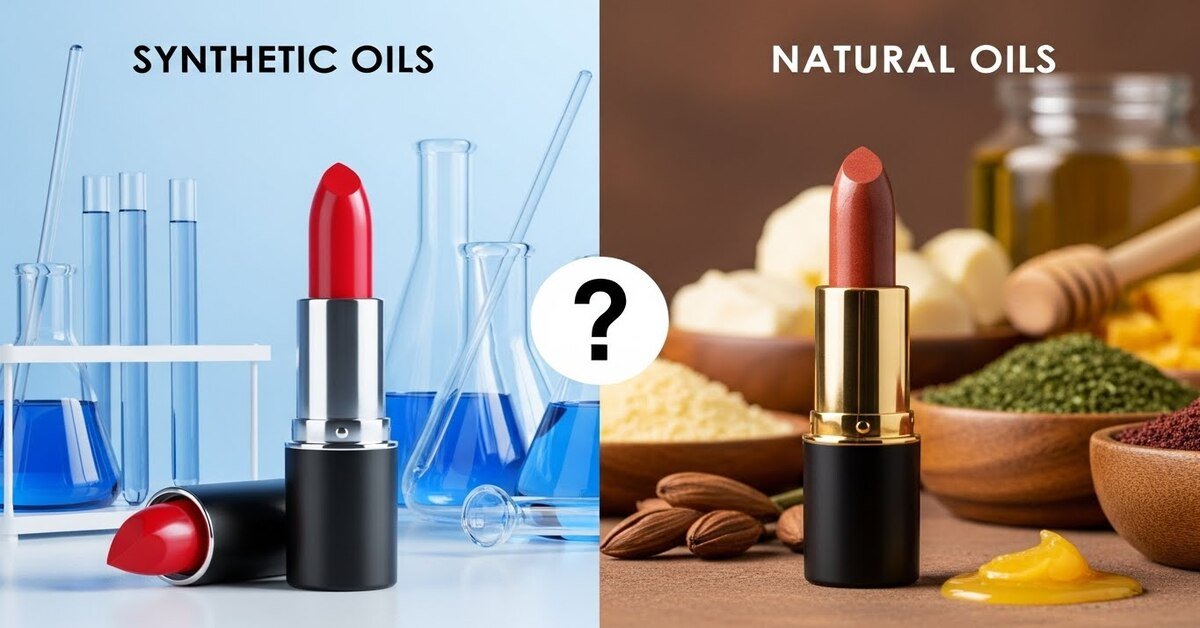
If you’ve ever compared two lipsticks—one labeled “100% natural” and another proudly “lab-formulated”—you’ve probably wondered which one your lips actually need. Natural sounds safer. Synthetic sounds stronger. But lipstick isn’t skincare marketing; it’s formulation science. That’s why the debate around Synthetic vs Natural Oils in Lipstick is far more nuanced than most people realize.
As beauty editors and formulators know, oils in lipstick don’t exist to “nourish” alone. They control glide, pigment payoff, stability, and how a lipstick behaves from the first swipe to hour six. And sometimes, the oil that performs best isn’t the one that sounds prettiest on the label.
Let’s break this down honestly—without fear-mongering, without greenwashing, and with real-world logic.
Why Oils Matter So Much in Lipstick
Lipstick oils aren’t chosen randomly. They affect:
- Texture and glide
- Pigment dispersion
- Wear time
- Finish (matte vs cream)
- Lip comfort
That’s why Synthetic vs Natural Oils in Lipstick isn’t about good vs bad—it’s about function.
To understand this balance, it helps to see how oils interact with wax systems, which is explained clearly in wax in lipstick.
What Are “Natural Oils” in Lipstick?
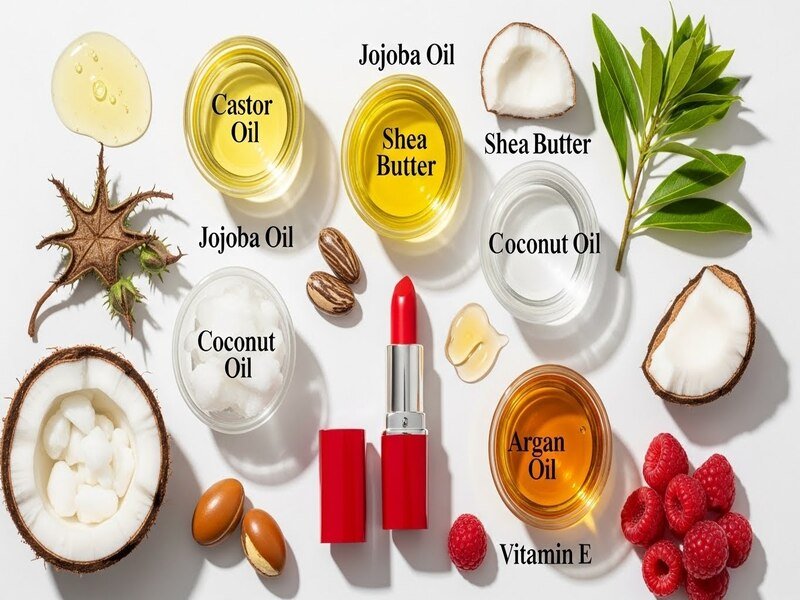
Natural oils come from plant or seed sources. Common examples include:
- Coconut oil
- Almond oil
- Jojoba oil
- Olive oil
In the Synthetic vs Natural Oils in Lipstick discussion, natural oils are often associated with comfort and gentleness.
Benefits of Natural Oils
- Good for dry or sensitive lips
- Familiar and skin-friendly
- Support the lip barrier
For example, jojoba oil closely mimics natural skin lipids, making it ideal for sensitive lips, as explained in Is Jojoba Oil Good for Dry or Sensitive Lips?.
Limitations of Natural Oils
- Less control over pigment
- Can feel greasy
- Less stable in heat
- Shorter wear time
This is where performance challenges begin.
What Are Synthetic Oils in Lipstick?
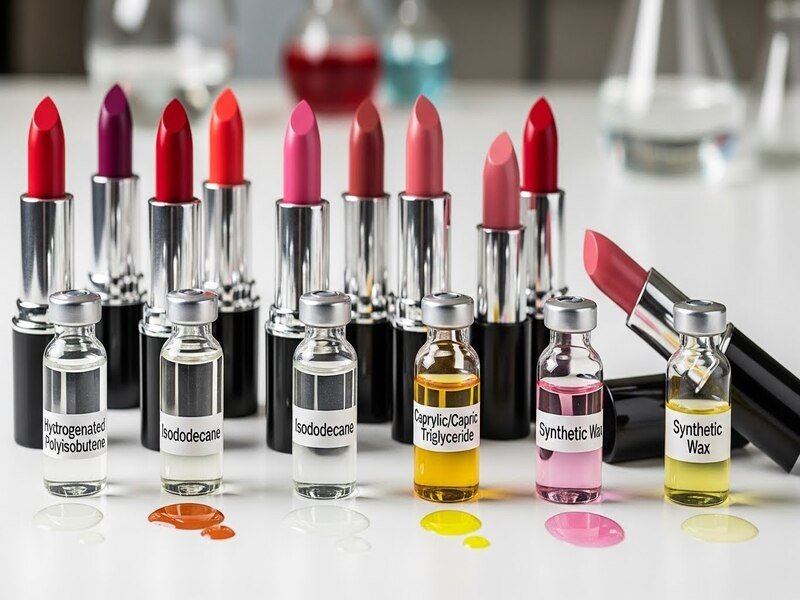
Synthetic oils are lab-created ingredients designed to mimic or improve upon natural oils. In Synthetic vs Natural Oils in Lipstick, these oils are often misunderstood.
Examples include:
- Hydrogenated polyisobutene
- Isododecane
- Synthetic esters
Benefits of Synthetic Oils
- Consistent texture
- Better pigment suspension
- Improved wear time
- Heat and oxidation stability
Synthetic oils are one reason modern lipsticks outperform older formulas.
Castor Oil: Natural, But Functional
Here’s where the conversation gets interesting.
Castor oil is technically a natural oil, but it behaves more like a performance ingredient. In Synthetic vs Natural Oils in Lipstick, castor oil often bridges the gap.
Why formulators love it:
- Excellent pigment-binding ability
- Controlled shine
- Smooth glide without slip
That’s why Castor Oil in Lipstick appears in both luxury and drugstore formulas.
From a safety perspective, dermatologists also support its use when properly formulated, as explained in Is Castor Oil Safe for Lips? What Dermatologists Say.
Performance Comparison: Natural vs Synthetic Oils
| Feature | Natural Oils | Synthetic Oils |
|---|---|---|
| Lip comfort | High | Medium–High |
| Pigment control | Low–Medium | High |
| Wear time | Shorter | Longer |
| Stability | Variable | Very stable |
| Sensory feel | Soft, nourishing | Smooth, controlled |
This table highlights the core truth of Synthetic vs Natural Oils in Lipstick:
Natural oils feel good. Synthetic oils perform.
Why Most Lipsticks Use a Blend (Not One or the Other)
Professional formulations almost never choose sides. Instead, they blend oils.
A typical lipstick may include:
- Castor oil for pigment control
- Jojoba or almond oil for comfort
- Synthetic esters for stability
This balance is what gives modern lipsticks their smooth feel and long wear. You can see how this works across finishes in castor oil in matte vs cream lipstick.
Matte Lipsticks: Why Synthetic Oils Matter More
Matte formulas demand precision. Too much natural oil can:
- Increase shine
- Reduce wear time
- Cause feathering
That’s why matte lipsticks rely more heavily on synthetic oils and controlled natural oils like castor oil. This is part of the Synthetic vs Natural Oils in Lipstick debate that consumers rarely see—but formulators live by.
Cream Lipsticks: Where Natural Oils Shine
Cream lipsticks have more flexibility. Natural oils like almond and jojoba improve:
- Cushion
- Lip feel
- Daily comfort
But even here, fully natural formulas struggle with stability, which is why small amounts of synthetic oils are still used.
Are Synthetic Oils Safe for Lips?
Dermatologists consistently emphasize one thing: safety depends on formulation, not origin.
Synthetic oils used in cosmetics are:
- Purified
- Tested
- Designed for repeated skin contact
This is why “chemical-free” marketing can be misleading—a topic addressed in organic vs chemical lipsticks.
Common Myths About Synthetic vs Natural Oils
❌ Myth: Natural oils are always safer
Truth: Allergies and irritation can come from natural oils too.
❌ Myth: Synthetic oils damage lips
Truth: Most are inert and barrier-friendly.
More myths like these are broken down in lipstick myths vs facts.
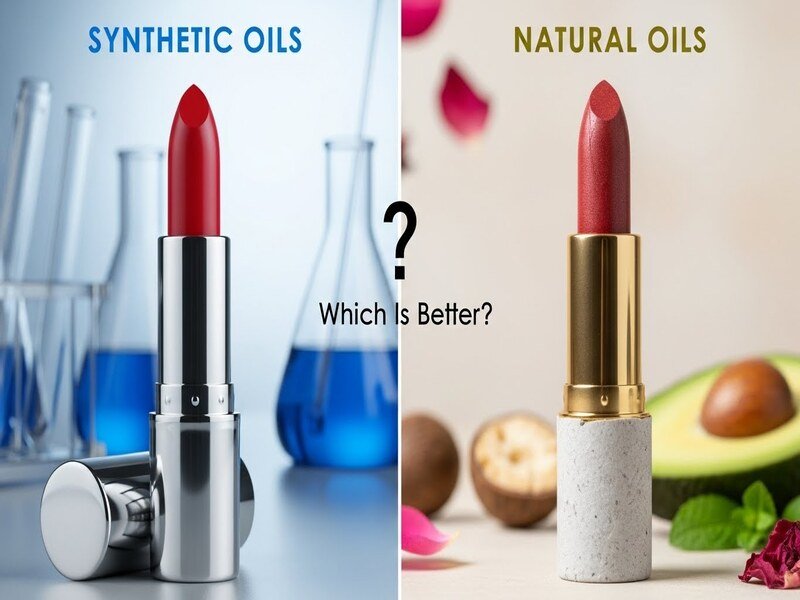
Which Is Better: Synthetic or Natural Oils?
So—Synthetic vs Natural Oils in Lipstick—which is better?
The honest answer: neither alone.
- Natural oils improve comfort and barrier support
- Synthetic oils improve stability, wear, and pigment performance
The best lipsticks combine both intelligently.
Final Verdict: Synthetic vs Natural Oils in Lipstick
When comparing Synthetic vs Natural Oils in Lipstick, the winner isn’t one side—it’s balance.
A lipstick that performs beautifully, feels comfortable, and stays safe for daily use almost always contains:
- A strong functional oil (like castor oil)
- Comfort-focused natural oils
- Carefully selected synthetic oils
Understanding this helps you shop smarter—and judge formulas by performance, not buzzwords.
FAQs
Are synthetic oils bad for lips?
No. When cosmetic-grade and properly formulated, they are safe.
Do natural oil lipsticks expire faster?
Yes, they can oxidize more quickly.
Is castor oil natural or synthetic?
Natural—but functionally similar to synthetic performance oils.
Which is better for sensitive lips?
Balanced formulas with jojoba + controlled synthetics.
Why do luxury lipsticks use synthetic oils?
For consistency, stability, and long wear.